
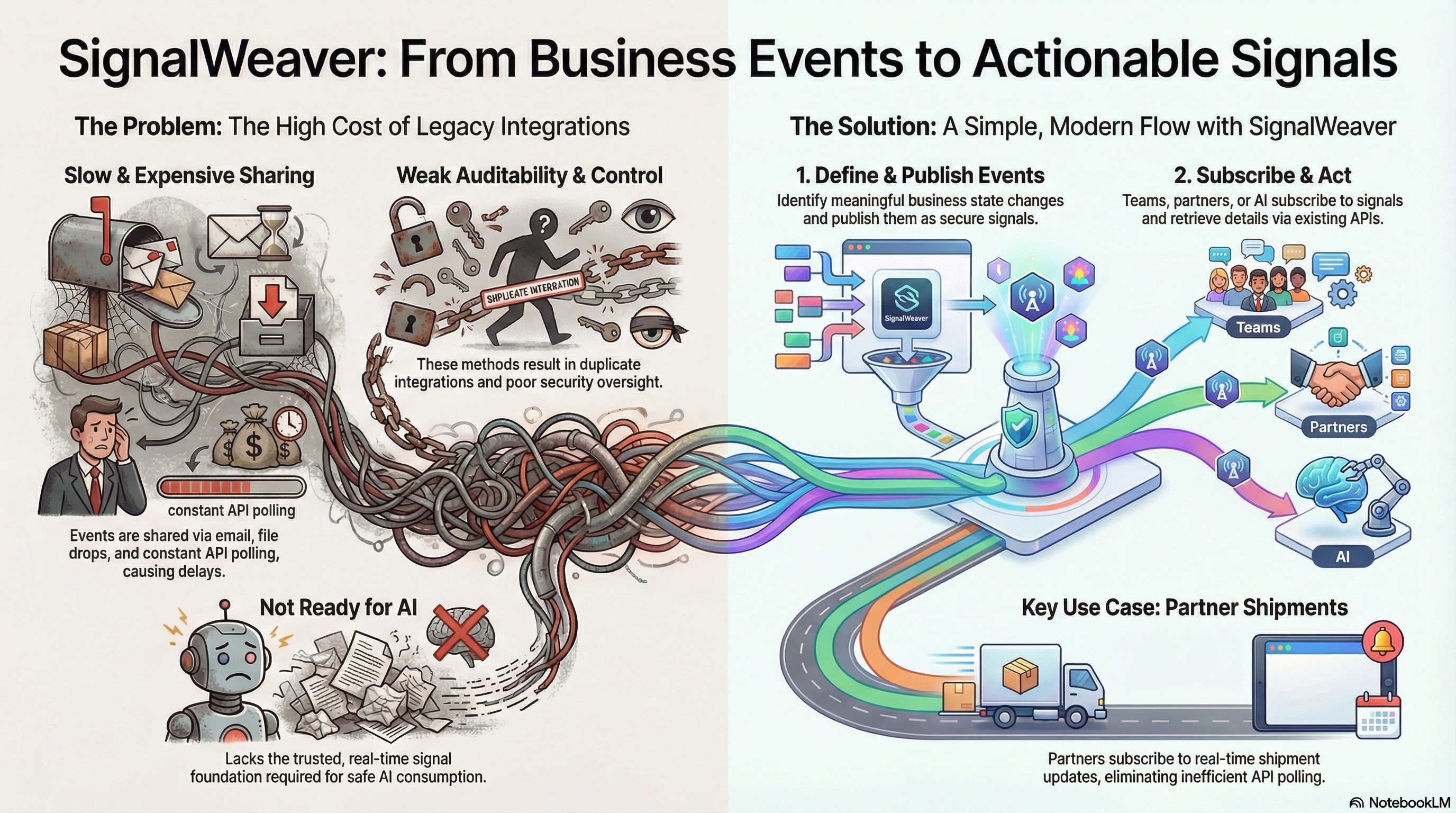
Business flow can only be preserved by capturing what happens as it happens.
Capturing events is simple. What happens next is a choice.
Follow the flow to see how SignalWeaver guides understanding before action.
Waste occurs when decisions are made without insight into how the problem formed.
Problems develop over time, yet solutions are designed in a moment.
What happened before the problem surfaced?
Tough question because the events that led to the problem are rarely captured.
When a problem becomes visible, much of what happened before has already disappeared.
What remains are fragments, assumptions, and partial records.
The broader business flow is lost, making understanding difficult and the analysis incomplete.
What’s missing is a simple way to observe how things unfold.
SignalWeaver provides that visibility.
Business flow can only be preserved by capturing what happens as it happens.
Capturing events is simple. What happens next is a choice.
SignalWeaver introduces listeners as optional interpreters of this flow.
A listener does not change what happened. It observes the sequence and applies perspective.
Different listeners can look at the same events and reach different conclusions, without altering the underlying record.
This allows understanding to emerge naturally, before any action is considered.
Events create opportunity for action, not obligation.
Captured events do not demand immediate response. They create the conditions for analysis.
Understanding does not come only from the events themselves, but from their timing.
When events occur.
How often they occur.
What happens between them.
Patterns emerge in the gaps, delays, and sequences.
This is where insight forms, before any action is taken.
This is not additional work.
It replaces the hidden cost of acting without understanding.
The effort already exists, in rework, reversals, and missed causes.
Capturing and analyzing events simply makes that cost visible.
By understanding the environment before acting, decisions improve and unnecessary work disappears.
Less reaction.
Less rework.
Less waste.
At some point, understanding leads to a decision.
An event becomes a signal, not because it occurred, but because the flow around it indicates something needs to happen.
Intervention is based on sequence, timing, and context, not on a single moment in isolation.
Action is no longer reactive.
It is intentional.